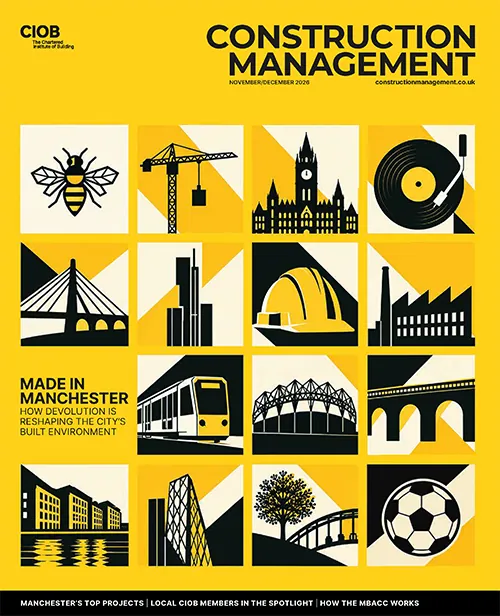



We asked five CIOB members working across the region what they see as Manchester’s strengths – and what is needed to support the city’s next phase of growth

‘Manchester has major-city ambition’
Leigh Renshaw FCIOB, CIOB Client Champion and associate director – construction, AstraZeneca

Manchester is an incredible place from a built environment perspective. What really stands out is the people. There is a strong sense of shared purpose, an incredible work ethic and a willingness to get things done – with plenty of northern grit and humour. I am proud that Manchester has held on to its strong city-region identity and industrial roots. As its history shows, the scale of the city’s ambition and innovation is significant. Manchester has major-city ambition, but its city-region identity encourages people to think beyond individual projects and consider regional value and long-term growth.

That ambition can only be delivered if the region has enough competent people with the right technical, digital and sustainability skills. For me, that is probably the biggest challenge facing construction in Manchester.
It is not simply about having enough people. We need competence in building safety, quality management, digital delivery, low-carbon construction and retrofit. Skills, therefore, need to be treated as a strategic delivery issue, rather than simply a recruitment problem.
That is particularly important as the industry responds to the changing regulatory and professional environment. We need people with the right skills, knowledge, experience and behaviours, alongside the right leaders, policies and investment.
I would identify four connected areas of capability that Greater Manchester needs: core construction competence; quality and building-safety management, including modern methods of construction; low-carbon and retrofit skills; and digital and data capability, including AI.
There is credible innovation happening in Manchester around retrofit, modular and prefabrication, but innovation should ultimately be judged by the outcomes it produces rather than whether a new technology has been used. We should build more efficiently, safely and to excellent standards, while reducing environmental impact.
We started the Industrial Revolution, so there is no reason why we cannot take a similarly pioneering approach to the digital and AI revolution and become leaders in applying those technologies across the built environment.
The other major issue for Manchester is infrastructure. If I had to identify one priority to unlock the next phase of growth, it would be integrated infrastructure planning, with transport capacity, investment and connectivity at the centre of development. That needs to be non-negotiable.
The development around the Etihad Campus over the past decade has been incredible, but access routes, pedestrianisation and tram infrastructure are essential to deal with travel and transport bottlenecks.
The same applies to development around Deansgate and the proposed New Trafford development. Transport improvements need to be considered from the outset if future development is to add genuine value to Manchester and the wider Greater Manchester region.
Ultimately, successful growth has to be sustainable, professionally delivered and leave a positive legacy for future generations. All the diverse elements of the built environment are joined together by the transport routes that allow people to move around the region.
‘This city is not scared to try new things’
Jason McKnight MCIOB, founder and co-director of Recom Solutions, a CBC

I have worked in Manchester since 2003 and the skyline has changed dramatically. You can see the growth of Tier 1 contractors, developers and major regeneration schemes across the city.
What stands out most is Manchester’s willingness to embrace innovation. Manchester
is exciting and it is not scared to try new things. You can see that in the regeneration plans across different parts of the city, from Co-op Live and the development around the Etihad Campus to Piccadilly Gardens and the plans for Piccadilly Station.
The city centre is increasingly acting as a nucleus from which investment and development are spreading into surrounding areas. But public infrastructure needs to keep pace with that growth.
The boroughs in and around the city centre are growing, but healthcare facilities, schools and civic buildings do not necessarily evolve as quickly. They need to develop alongside the population and economic growth.
What makes Manchester particularly exciting is the combination of construction and regeneration with the growth of the digital economy. The expansion of technology and digital start-ups is generating demand for new offices and developments, while also influencing how those buildings are designed.
There is a real focus on what the next generation of workers will be like and who is going to be attracted to Manchester. The city is competing for businesses and inward investment from across the UK and overseas.
Exactly what the next phase of Manchester’s development will look like is difficult to predict, but that uncertainty is part of the appeal. We do not know what it will look like, but it is very exciting to be part of that evolution.
‘Manchester has to determine whether its ambition can be matched by its ability to deliver’
Rob Gutteridge MCIOB, CIOB Manchester Hub chair and senior project assurance specialist with URENCO Ltd

I came to Manchester 30 years ago, having previously worked around the UK and abroad, and have seen the ups and downs of the construction industry here.
I have never felt at home anywhere else in the way I do here.
My children are growing up in the city and are rightly proud to be part of a forward-looking place. Manchester has its problems, like anywhere else, but it seems able to deal with them proactively and progressively.
The Greater Manchester Combined Authority shows how collaboration can work when boundaries are set and managed across a city-region. That is important because the challenges facing construction and development do not stop at local authority boundaries.
Manchester now has to determine whether its ambition can be matched by its ability to deliver. There are shortages across most, if not all, trades. Part of the problem is the chicken-and-egg situation of getting young people interested in construction and providing opportunities, while businesses are trying to create value over relatively short projects.
Larger companies with longer order books are often better placed to invest in apprenticeships, but SMEs need help to kick-start the skills resource at trade level. Greater engagement with schools and colleges, backed by a strategic plan involving GMCA and professional bodies including CIOB, could make a difference.
There is also an interesting balance to strike in how Manchester develops. How do we meet the needs of existing communities while attracting growth and new business?
That means allowing innovation and modern development alongside regeneration. Greater Manchester’s skyline shows differences between the south-west, with its high-rise development, and areas such as the Northern Quarter and Ancoats, where regeneration has taken a different form.
That seems part of a deliberate approach to maintaining the “Manc” culture while modernising and regenerating the city.
‘Manchester has an opportunity to shape the industry’s future’
Martin Horne, regional managing director – building north, Tilbury Douglas

Greater Manchester has significant opportunities for construction, but also a significant challenge in making sure we have the people and skills needed to deliver them.
For me, the skills issue is one of the biggest facing the industry. We need to look beyond simply recruiting people and think about how we create the right pathways into construction.
That means much closer collaboration between construction employers, education providers and the wider industry. What people are learning needs to reflect the skills employers actually need, while young people also need real-world experience of the opportunities available to them.
The Greater Manchester Institute of Technology in Salford is a good example of what that can look like. It brings education and industry together and gives students access to technologies and working environments that reflect the changing nature of construction. That kind of industry-led approach can help create the talent pipelines Greater Manchester needs.
But skills are only part of the picture. Construction also has an important role to play in the wider economic and social development of the region. When we deliver projects, we should be thinking about how we create opportunities for local people and businesses, develop apprentices and leave a lasting benefit in the communities where we work.
We also need to make sure the buildings and infrastructure we deliver are fit for the future. Sustainability and technology are changing the way we work, so the next generation needs to understand those changes and be able to work with new technologies.
Greater Manchester has a strong construction and engineering heritage, but it also has an opportunity to shape what the industry looks like in the future.
Ultimately, our role is about more than delivering buildings. It is about helping to create the workforce, opportunities and communities that will support growth for years to come.
‘We try to make education as close to real construction as possible’
Nicola Harris, DSBNE quality lead placements and employability tutor for UG & PG built environment and senior lecturer in construction management, University of Salford

This is a huge time of change for Manchester. One of the biggest challenges is making sure we have the people with the skills to support growth. We need a joined-up approach between universities, colleges, employers and professional bodies, giving young people – or anybody interested in the built environment – a pathway into the industry.
At Salford, we work closely with contractors, colleges and organisations including CIOB. Our industry advisory panel gives employers an opportunity to highlight emerging skills requirements.
It is increasingly not just about technical knowledge. We need to give students communication and transferable skills for the workplace.
We try to make education as close to real construction practice as possible. Students work on projects, using briefs, programmes and risk assessments. Employers come into presentations and site visits, helping students understand why their learning matters.
Students have opportunities to present, run meetings and communicate with different stakeholders – essential construction skills. Our classrooms bring together students, apprentices and part-time learners of different ages, reflecting the workforce they will join.
I do not think you can separate education and industry. Whether someone is on any programme, there needs to be a pathway into it.