












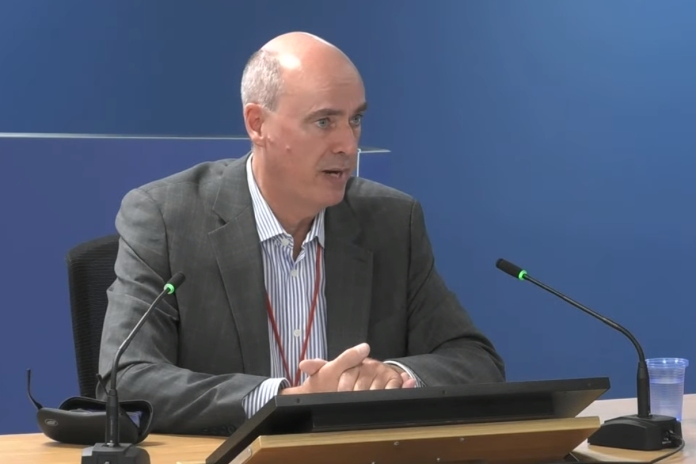
The director of assets and regeneration at the Kensington and Chelsea Tenant Management Organisation (TMO) didn’t ask an “obvious” question about whether or not the architect that designed the refurbishment of Grenfell Tower had previously been involved in cladding a high-rise residential building, the Grenfell Tower Inquiry has heard.
Mark Anderson, who was interim director of asset investment and engineering at the TMO from 2010 until he became director of assets and regeneration in April 2012 before leaving in 2013, admitted to counsel Andrew Kinnier that he had not asked the question of Studio E.
Kinnier put it to Anderson: “It’s an obvious question, isn’t it?”
Anderson replied: “It is now. I don’t know why I didn’t ask that question.”
Kinnier said: “With respect, Mr Anderson, it was an obvious question then: have you been involved in cladding a high-rise residential building? That’s what you were asking them to do.”
Anderson said: “At that stage, the type of cladding had not been determined. The questions that were asked of Studio E, or more specifically [Studio E director] Andrzej Kuszell, by myself and others was: have you done residential refurbishment projects? The response to that was that they hadn’t as a practice, but individuals employed within the practice had done. They’d also done cladding, as in overcladding projects, as a practice and individuals within the practice.”
Kinnier asked Anderson if he had asked Bruce Sounes from Studio E, who later became involved in the project, if he had been involved in overcladding. Anderson said that he had.
Later on in the hearing, Kinnier asked Anderson if the “pragmatic benefits” of using Studio E because of their connection with another local project, the Kensington Academy and Leisure Centre (KALC) came first, or looking at their qualifications, expertise and experience?
Anderson said: “I think it was a combination of both.”
Kinnier raised a report presented to the Royal Borough of Kensington and Chelsea (RBKC) cabinet by Laura Johnson on 2 May 2012 which said: “The TMO has appointed the same design team as that for KALC to assist in the project management of detailed matters such as the co-ordination of design, consultation, public realm, site access , and works. The TMO also anticipates employing the same contractor and this is intended to ensure that the two projects are able to deliver cost savings where possible, and produce schemes that are complementary in their appearance and function. For this reason, and subject to the Cabinet’s approval, there is a need to ensure that the Grenfell Tower project is permitted to proceed without delay.”
Kinnier asked Anderson if his view was that using the same project team for design and contractors would produce a significant financial saving?
Anderson replied: “That wasn’t one of my drivers. That said, if you have a pre-construction professional team working on one project and then add to that, ie a separate project, you would expect to realise some efficiency through that.”
Kinnier asked: “Would you agree that the impression given, certainly by this minute, is that cost savings was a significant consideration in using the same design team?”
Anderson said: “I can’t answer to that, this is an RBKC Cabinet report.”
Kinnier continued: “Was there pressure from within TMO, first of all, to keep the budget to the lowest possible minimum price?”
Anderson replied: “I think with any project that you carry out, you want to deliver your outputs for the lowest possible cash sum… That doesn’t mean to say that the driver was cost alone, because that certainly wasn’t my impression.”
The Inquiry continues.
Comments
Comments are closed.




I hope that after this inquiry the Scheme Design Process, Tender Procurement and Contract Control and responsibilities return to simplification. It seems that the original specification of materials and any later variations did not go through a robust simple process of approval with defined responsibilities prior to construction.
Peter Anderson