











Six applications of AI made the shortlist for Best Use of AI at the Digital Construction Awards 2026.
This category celebrates the innovative application of AI to enhance and transform human processes, productivity, project outcomes and overall client satisfaction within the built and managed environment. We sought entries that demonstrated measurable, tangible benefits and genuine impact through AI implementation, not just theoretical or “hyped” examples.
Here are the six applications of AI that made the shortlist.
BidLevel | ProcurePro
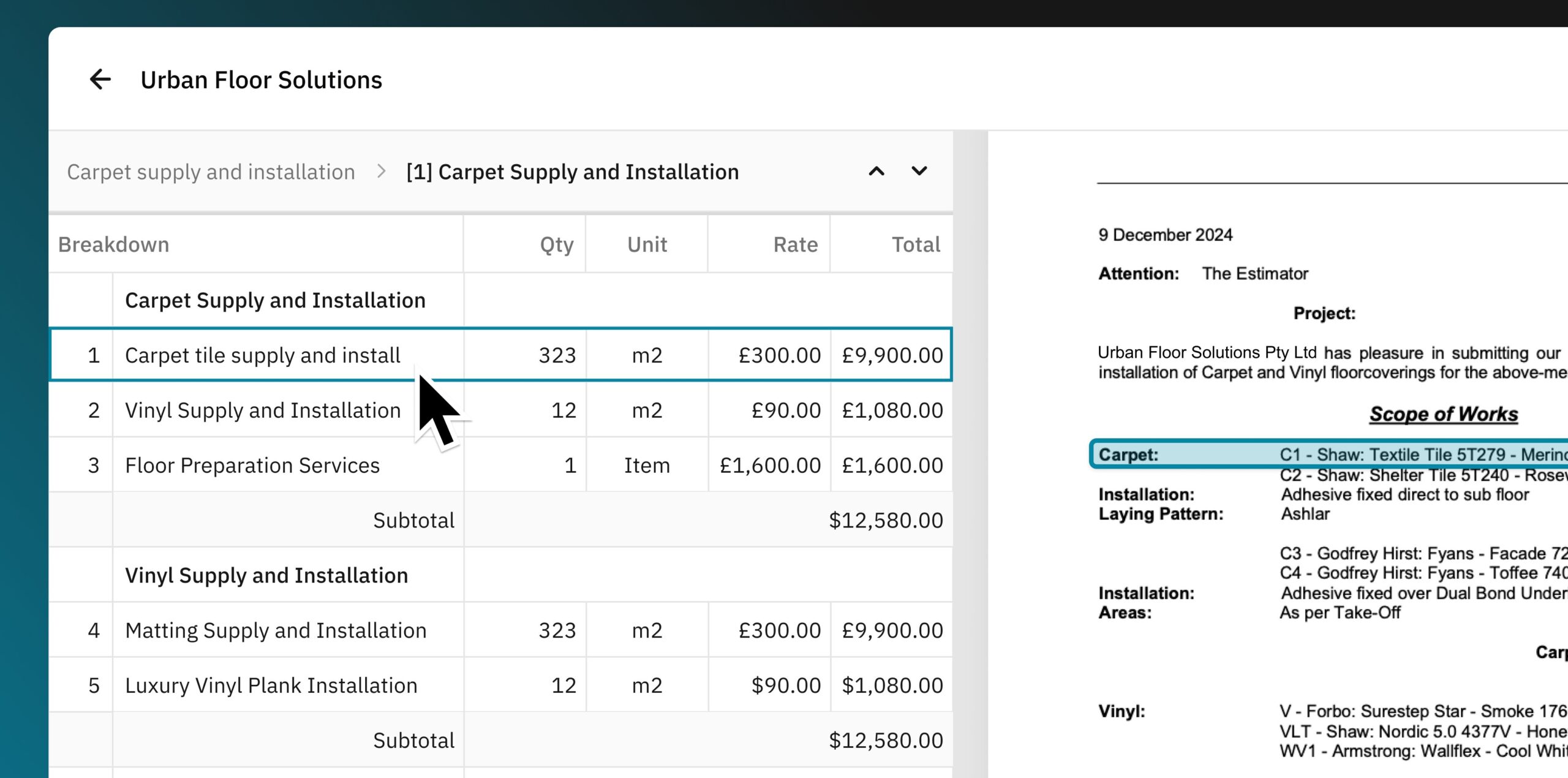

In pre-construction, estimators face one of the most manual and error-prone workflows: levelling vendor quotes. Each tender includes dozens of pdfs, formatted differently, requiring hours of copying, re-entry and comparison. This drains time from high-value analysis and introduces financial and compliance risks.
BidLevel’s challenge wasn’t just to automate a spreadsheet task, but to teach software to understand construction language across thousands of unique quote formats, suppliers and scope definitions. No existing technology could accurately extract structured pricing and scope data without extensive human correction.
Manual quote levelling directly impacts speed to tender, project accuracy, and profitability. Solving this problem would unlock measurable time savings and reduce risk across the construction supply chain.
BidLevel uses AI to extract, standardise and present comparable data instantly, turning a multi-hour manual process into one that takes minutes. Estimators upload quotes, the system aligns line items, surfaces inclusions and exclusions, and produces an apples-to-apples comparison in minutes.
Traditional pdf processors lose the table structure when connecting items to quantities and costs. BidLevel retains structure so the LLM preserves cell-level context, enabling reliable extraction.
BidLevel draws on ProcurePro’s real project data and pattern libraries and pairs them with construction-tuned models to refine extraction and alignment. Using construction-specific data and models, BidLevel improves recognition of trade terms, scope notes, alternates, provisional sums and exclusions, and produces contextualised outputs.
The system respects both objective extraction and subjective comparison and uses confidence markers, highlighting uncertain mappings and allowing in-place edits.
Early challenges included nested tables, merged cells, and varied layouts, which were solved with structure-aware parsing and quote-specific heuristics. Users can adapt their breakdowns to company standards.
BidLevel has turned an inefficient, manual process into a fast, accurate, repeatable workflow. A typical package now receives a standardised breakdown in about 60 seconds. Live use shows an 80% reduction in time, accelerated tender reviews, and improved accuracy of estimates. Typical feedback from customers is that their time now goes into cross-checking that key information is included rather than building everything manually. Others highlight the surprise of uploading pdfs and seeing the right details pulled out, which is where the real time-saving happens.
District One | Ramboll
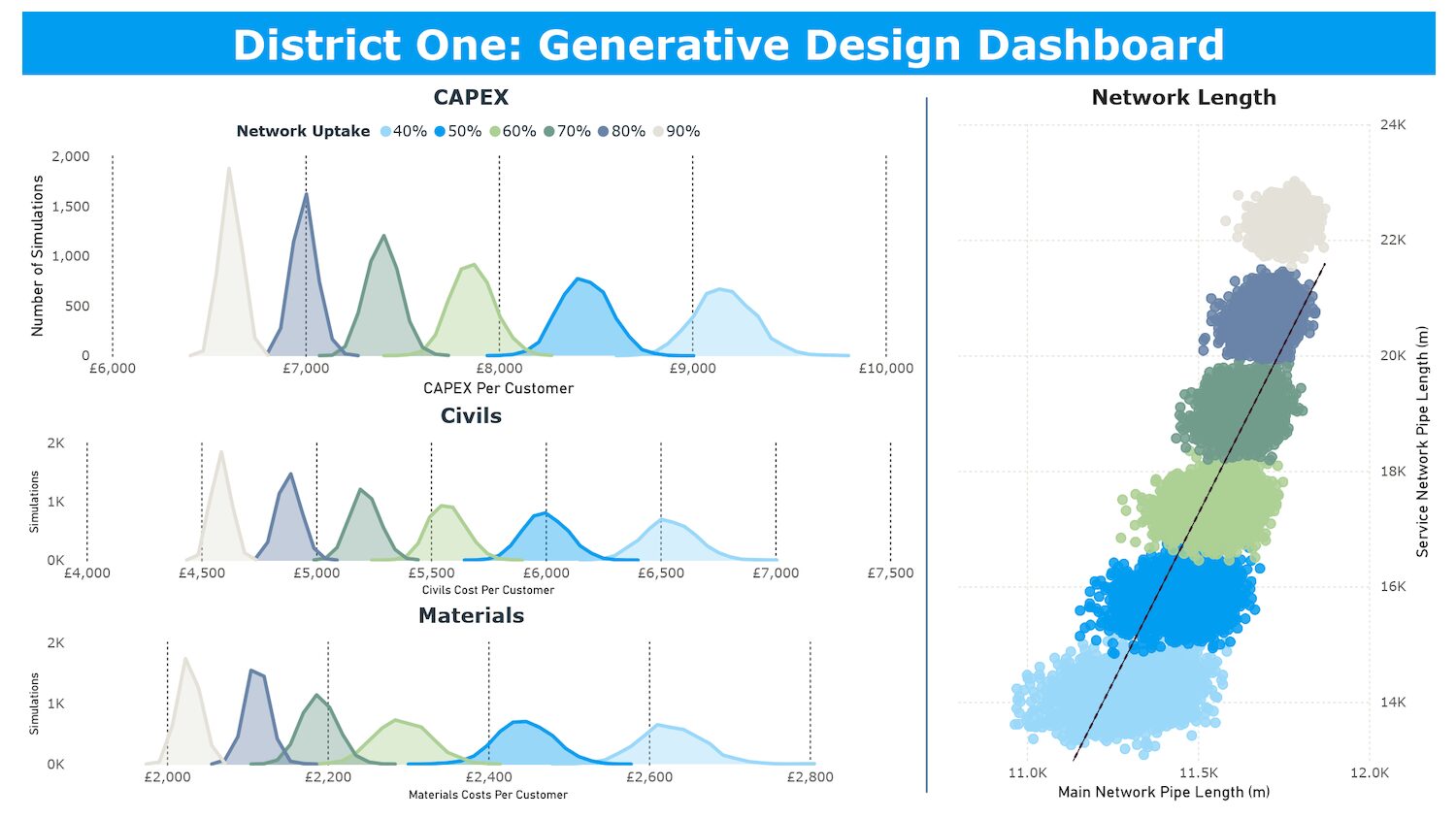
Ramboll and Vattenfall formed a partnership to enhance District One into a generative design and probabilistic simulation engine for district energy. Rather than planning for one scenario, it creates thousands of possible futures with different household connections, designs a realistic network for each, sizes the pipes and quantifies costs and risks. This is ideal for evidence-based investment planning.
District One automatically generates heat‐network routes using unsupervised machine learning algorithms to form clusters, from the energy centre to properties, avoiding “over‐optimisation” traps. Households are grouped into type – such as owner-occupied, private rented and social – to make predictions realistic and reflect real behavioural and economic impact. Networks are sized to CP1 (2020), distinguishing main and smaller service pipes.
The approach runs on existing data such as addresses and roadmaps, allowing consistent, defensible decisions across areas. Companies can plan large projects in stages, reducing route creation from weeks to hours.
Conventional planning relies on a handful of deterministic scenarios and manual GIS routing. District One raises organisational literacy in probabilistic decision‐making, offering faster modelling, enabling decision‐makers to see the shape of risk before committing resources.
Ramboll’s method designs networks under many plausible futures, quantifies uncertainty as distributions (cost, length, pipe counts), and highlights the most‐probable networks via overlaid iterations.
Ramboll and Vattenfall’s approach applies AI to network design under behavioural uncertainty, combining tenure‐aware sampling, engineering‐grade sizing and statistical convergence into a single workflow. Instead of a single “best guess”, the platform produces probability distributions for capex, network length and segment counts across thousands of plausible futures, stopping at a 95% confidence interval. This approach generates a rich evidence base that could save up to £32bn nationally, according to Ramboll.
NavLive
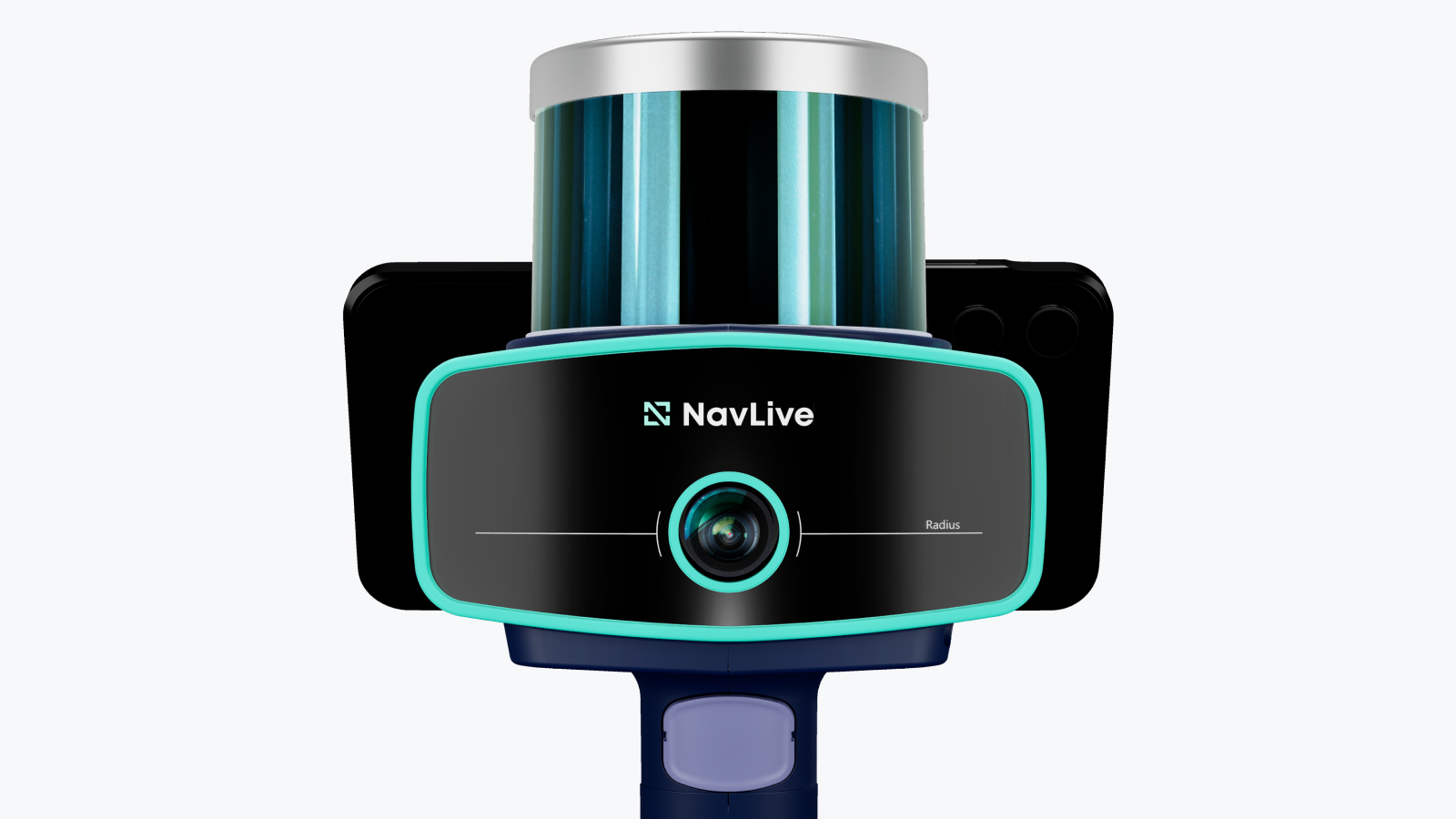
NavLive set out to develop a handheld, AI-powered scanner to generate usable building data, including 2D floorplans, elevations, and 3D point cloud models, in minutes, directly on site.
The goal was to democratise high-quality spatial data capture, giving architects, surveyors and construction professionals the ability to verify as-built conditions instantly, without manual processing or cloud dependency. Early research involved testing sensor fusion methods and edge AI models using the NVIDIA Jetson platform.
NavLive’s innovation lies in the seamless integration of AI, LiDAR and high-resolution photography, processed on-device through a proprietary algorithm. The system recognises and aligns spatial features, automatically reconstructing outputs such as point clouds, floorplans and elevations.
The handheld scanner precisely tracks its position while mapping the surrounding environment as the user walks. Using edge computing, the system processes camera imagery in real-time to detect and classify objects such as walls, windows and doors. These objects are then integrated into an AI-generated floorplan. Deep learning is applied to the point cloud data, segmenting up to 20 object classes to enhance understanding.
The resulting floorplan can be exported directly in DXF format for compatibility with Autodesk, Revit and other CAD applications. It also produces LOD 300 3D models that can be used in SketchUp and Revit to support the creation of BIM models.
Object recognition is performed directly on the device, eliminating the need for internet connectivity or cloud servers. The model was trained on hundreds of real-world building datasets. It enables real-time, in-field validation.
During development, NavLive upskilled its engineering team in deep learning optimisation, AI model compression and sensor fusion.
NavLive’s AI-driven scanner has already delivered measurable improvements for early adopters in the UK, including AWW Architects and BW: Workplace Experts. Projects that once required days of surveying and manual data processing can now be completed in under an hour.
For example, using NavLive’s scanner and AI software, BW scanned an eight-storey bank in London in under 30 minutes, generated floorplans instantly, and produced a BIM model within hours. Previously, this process required multiple surveyors and a two-week turnaround. The project alone saved BW around £50,000 in time and cost.
Scaling information management in the AI era | Hoppa AI/AtkinsRéalis
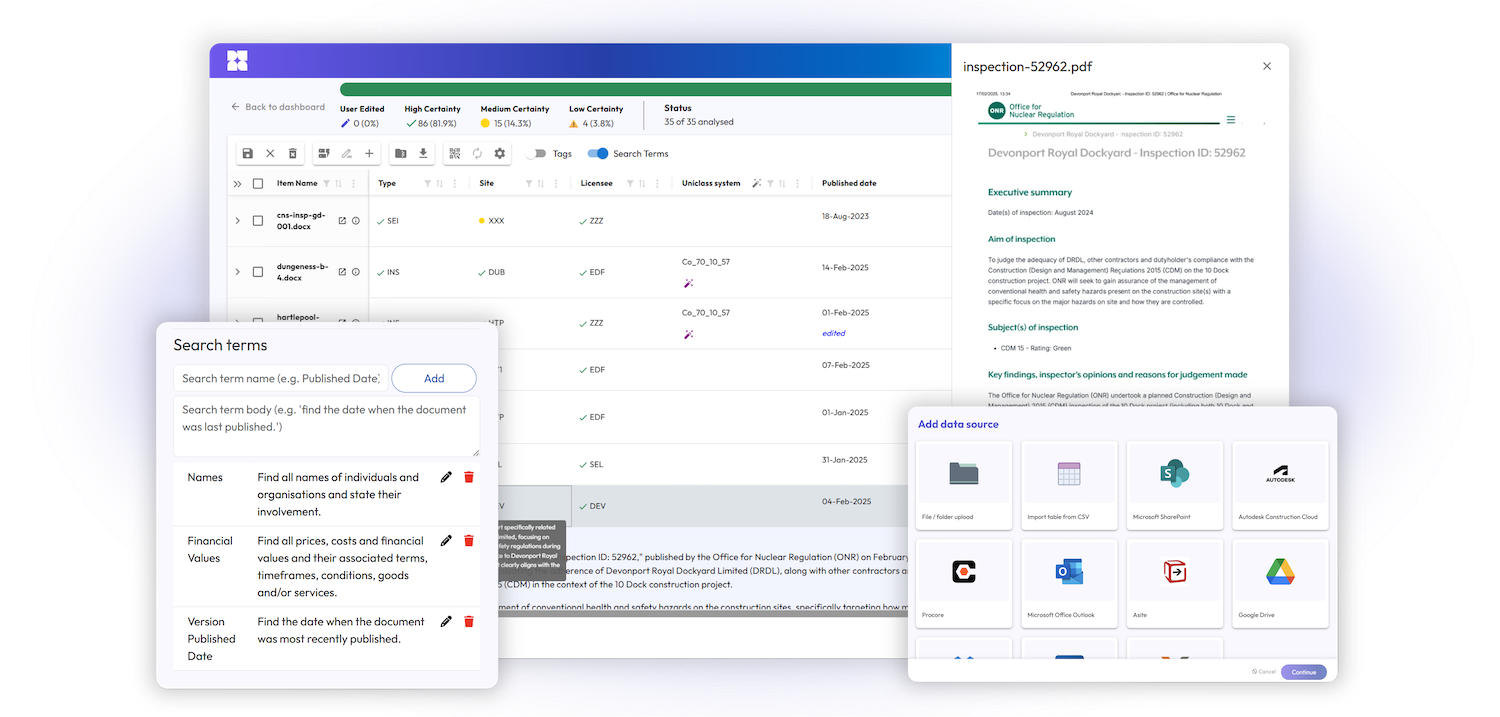
Asset owners can spend months tracing critical information, forcing teams to resurvey, redesign, or proceed with uncertainty. The result is overruns and safety risks. Yet effective data governance at scale is often impossible. During one nuclear project, AtkinsRéalis found full remediation would take 15-20 years. On another design-and-build tender, information management tasks were forecast to consume 40% of engineering time.
With remediation costs so high, AtkinsRéalis identified pilot opportunities to leverage AI to augment human information-management specialists and apply governance.
Working with Hoppa AI (a UK startup specialising in AECO data translation, classification and governance), the project focused on demonstration of value for a large-scale (tens of thousands of documents) application on a nuclear decommissioning project, and a small-scale (thousands of documents) application for a design-and-build tender response in the water sector.
Starting with the nuclear decommissioning project, AtkinsRéalis and Hoppa adopted a human-in-the-loop AI approach combining:
- ISO 19650-compliant metadata specifications and analysis workflows;
- natural language processing and other AI-based tooling, including from industry-specific file types (Inventor, AutoCAD);
- AI classification and labelling systems, vector similarity, inductive reasoning and more; and
- human-in-the-loop validation.
Hoppa’s kit-of-parts workflow engine (Workbench) enabled the team to tailor client solutions faster, while a cross-domain approach bridged information siloes.
The pilot was conducted in a live project setting, tested and hardened on short iteration cycles. Human oversight ensured scale and accuracy. The result: a trained, Hoppa-enabled operator completed a data-cataloguing exercise 100 times faster.
The capability was then deployed on a smaller-scale water pipeline tender, processing thousands of records. What would have taken six weeks manually was completed in three days.
The solution is now being applied for a major aviation authority. AtkinsRéalis and Hoppa are processing legacy asset records to extract key details. This data feeds an insights engine to help predict issues before they arise.
The AI-enabled approach to data mining and classification turns data into long-term business assets. Measurable benefits include:
- a 90% reduction in time classifying and cataloguing historical documents;
- 10 times improvement in data retrieval and quality validation;
- thousands of human hours saved; and
- increased confidence and compliance, with every AI-derived classification traceable and verifiable.
The Knowledge Hub AI: redefining how Willmott Dixon wins with intelligence | Tribus Digital/Willmott Dixon
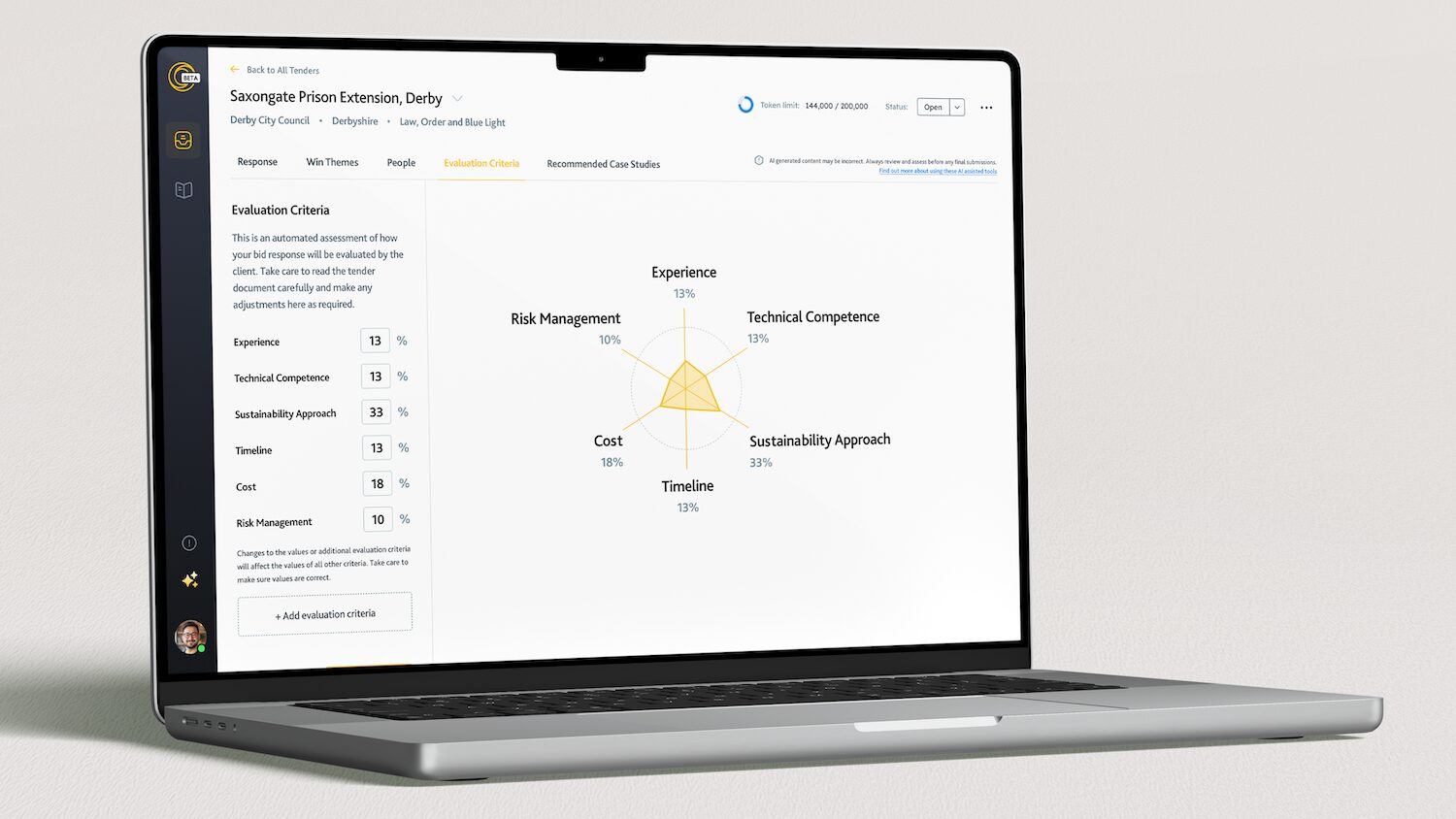
In 2023, Tribus Digital helped Willmott Dixon launch The Knowledge Hub, a platform for consolidating business and project information, providing in-depth responses to bids/tenders. Last year, Willmott Dixon tasked Tribus with creating an AI application to optimise and address key opportunities and challenges to the hub.
These challenges included:
- time saving – 86% of bid teams wanted to spend less time at the first stages of a tender;
- protecting IP;
- improving wellbeing – 71% wanted it to be easier to find information and help with tight turnarounds;
- maintaining a competitive edge – 79% wanted to spend less time making changes to bids and more time adding value or driving innovation; and
- creating a tool that people would actually use and meet their needs and expectations.
Using Anthropic Claude, hosted on AWS Bedrock, Tribus’s AI application capitalises on The Knowledge Hub’s existing content, giving Willmott Dixon a competitive advantage.
Taking information from the business’s practices, projects and expertise, the application provides users with a chat-like interface, allowing them to automate tasks, safely use data and focus time on producing high-quality, valuable content.
Challenges were addressed in the following ways:
- saving time – features included AI chat/search, reducing search times from minutes to seconds, documenting ingestion to populate bid criteria, and first drafts in minutes rather than hours. So far, 28-plus hours per average bid have been saved, with first drafts for nine-question bids achieved in 4 minutes 37 seconds, saving £147,924;
- protecting IP – customised product and secure platform within The Knowledge Hub, hosted in AWS, ensuring data privacy;
- improving wellbeing – AI stakeholder review to audit tenders, identify information gaps, rather than hallucinate. 100% of users reported saving time when sourcing evidence;
- maintaining a competitive edge – automation freed expert time to create work-winning content and improve win rates; 100% of users said it freed up time for value-adding work; and
- creating a tool that people would actually use – discovery framework informed design, users were upskilled, AI guidelines created, and ongoing surveys conducted.
The application was developed in six months and return on investment is predicted within seven months.
Transforming inspection test plans with AI | Taylor Woodrow
Construction projects routinely lose value to avoidable errors – around 21% of project value is wasted. A major contributor is inadequate inspection and test plans (ITPs) and check sheets lacking explicit acceptance criteria, according to Taylor Woodrow.
Producing ITPs requires manual searches across extensive specifications and cross-referenced standards, making the process time-consuming and inconsistent. AI can address critical needs to:
- reduce manual effort in extracting requirements;
- improve quality by enabling engineers to focus on validation;
- reduce time and effort to generate ITPs;
- improve quality and consistency through traceable acceptance criteria; and
- build a central knowledge base to enhance ITPs.
Taylor Woodrow mapped existing ITP processes to pinpoint where AI could add value, identified core pain points, and adopted an iterative development strategy with domain experts to refine outputs and build trust. Early pilots validated the decision to implement a human-in-the-loop model for accuracy and compliance, tackling information overload, delivering faster, higher-quality ITPs and reducing rework risk.
Auto ITP is an AI-powered application that transforms the creation of ITPs and check sheets. Using natural language processing and large language models, it parses project specifications, follows inter-document references, and identifies precise tests and acceptance criteria, leveraging historical ITPs for consistency.
Unlike generic tools, Auto ITP generates project-specific ITP narratives, extracts numeric tolerances, technical requirements and responsibilities, and maintains clause-level traceability. Approved ITPs automatically generate clause-linked inspection check sheets for field use. The mandatory human-in-the-loop workflow ensures engineers review drafts, with feedback continuously improving the model.
Auto ITP improves on manual, template-based methods, automating laborious documentation and delivering speed, accuracy and consistency. A phased rollout and targeted training shifted Vinci engineers’ focus from information gathering to professional judgement and validation.
Baseline data shows Auto ITP users save more than 50% of drafting time. Surfacing complete acceptance criteria and clause-level traceability, Auto ITP avoids an estimated £474,700 in unexpected costs per year.
Celebrate with the best
The winner will be revealed at the gala dinner at the London Marriott Grosvenor Square on 18 March. You can join the shortlisted entrants by booking your seats at the awards. There is an early bird discount for those who book tables by close of play 23 January.
The Digital Construction Awards are organised by Digital Construction Week, the Chartered Institute of Building, CM and Digital Construction Plus. Bluebeam, nima and Sage are among the sponsors.
To find out more about the awards, head to digitalconstructionawards.co.uk.
To become an awards sponsor, email Karolina Orecchini.
Keep up to date with DC+: sign up for the midweek newsletter.