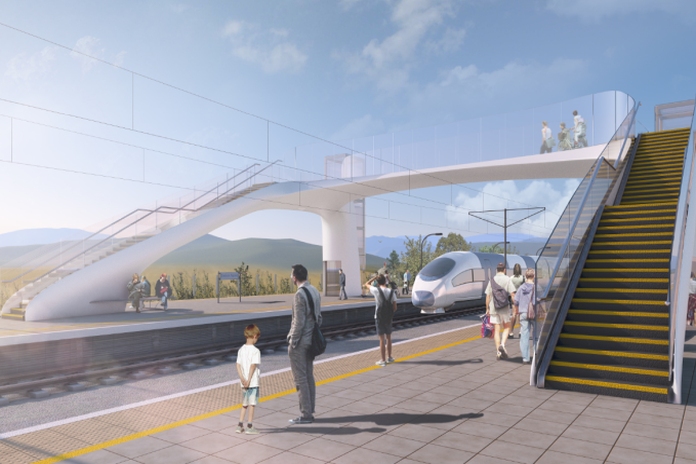
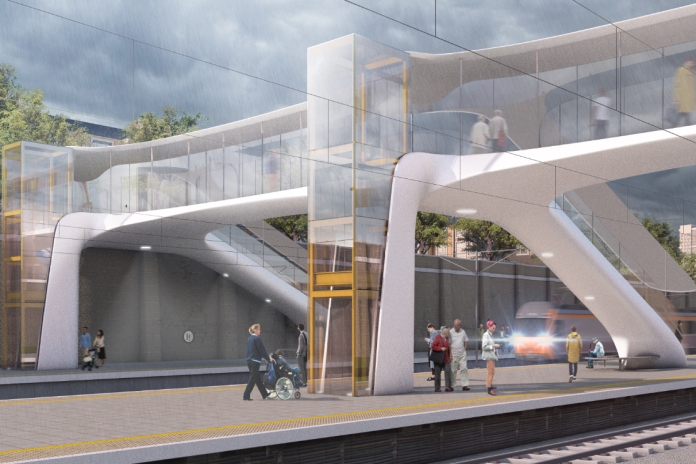
Network Rail has teamed up with the National Composites Centre (NCC) to design and build a footbridge made from composites.
The concept footbridge, called “Futura” and designed by Marks Barfield Architects and consulting group COWI, is being developed into a prototype to demonstrate the benefits of using composites within railway stations for both new-build and replacement structures.
The footbridge demonstrator project will adopt modern
methods of construction and platform architecture through a standardised design
and set of adaptable components created in factories with digital controls.
This is not a paywall. Registration allows us to enhance your experience across Construction Management and ensure we deliver you quality editorial content.
Registering also means you can manage your own CPDs, comments, newsletter sign-ups and privacy settings.
The NCC said the bridge would also enable innovation that can be transferred to the wider transport infrastructure and supply-chain. The project will target key metrics of reduced cost and reduced greenhouse gas emission in line with Construction 2025.
Richard Oldfield, chief executive of the NCC, said: “We’re
delighted to be working on this ground-breaking project with Network Rail, and
that they have joined us as a member. There is clear alignment between the
long-term strategic goals of the two organisations - namely to accelerate the
adoption of composites in construction and to support the UK’s supply chain
development to achieve the government’s Construction 2025 strategy.”
“Composites offer huge benefits to construction, not least
in their ability to be built using modern methods, as well as the
cost-effective nature of their construction and installation. They are a more
sustainable solution, which will contribute to net-zero targets across the
industry, and are an intrinsically safer and more aesthetically pleasing
option.”
Ian Grimes, principal engineer from Network Rail added: “Our
main focus is on putting our passengers first and exploring the full potential
of composites as an alternative low carbon construction material will enable us
to continue doing this.
“The quicker installation and the corrosion resistant nature
of composites will mean less disruption and impact on passengers when we’re
installing and maintaining our assets.
“This offers further environmental benefits alongside cost
savings which can then be reinvested into other parts of the network.”