












The Digital Construction Awards attracted more than 120 entries, 63 of which have been shortlisted. Here, we detail the Digital Innovation in Offsite Construction shortlist.
This category recognises the use of digital technology to enhance modular, offsite or modern methods of construction techniques on a project. Three high-quality entries made the shortlist:
33 Charterhouse Street | Prism & SES
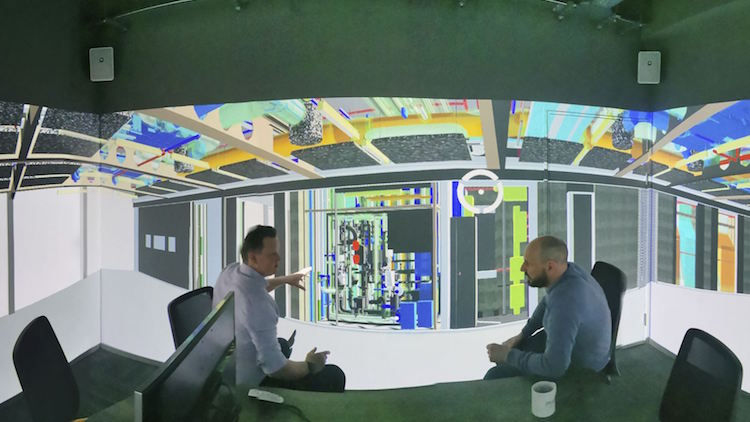
On Helical plc’s Farringdon office development, 33 Charterhouse Street, building services contractor SES’s Prism Offsite Manufacturing business addressed the challenge of ensuring that building services design was effectively and efficiently incorporated in the MEP coordination during stage 4.
SES adopted an immersive 3D workspace from Igloo Vision, allowing all project stakeholders to work collaboratively and ensure solutions were developed that are suitable for all parties.
The immersive workspace enabled: the use of 3D models to visualise the anticipated work interfaces and understand inherent and residual risks; the working at height risks; and the use of 4D planning for site logistics.
Ultimately the immersive workspace enabled the design team to review the complex areas of the scheme (in particular, the plate heat exchanger riser modules) in a realistic but virtual environment. This ensured the correct solution was produced before manufacturing started.
SES was also able to optimise and plan its factory layout, ensuring all the products for the scheme could be manufactured within the facility to suit the programme requirements in an efficient and safe working environment.
KOPE: Mace HRS | Matterlab
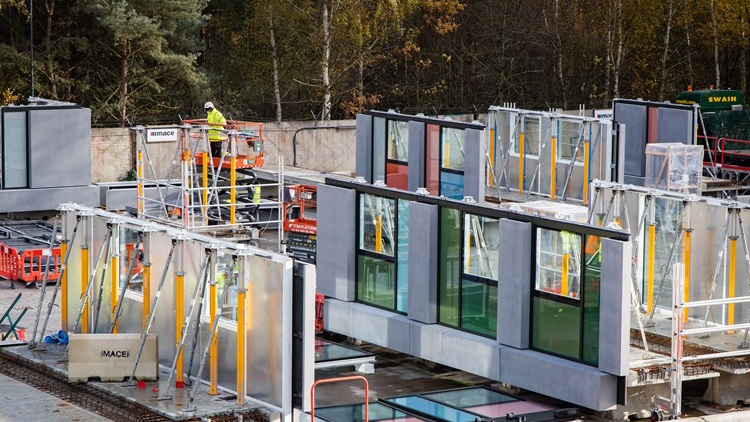
Matterlab worked with Mace to help the latter maximise the benefits of using its High Rise Solutions (HRS) by codifying the underlying logic of the precast floor units into its KOPE platform. HRS works with a set of components to design and manufacture the structure and facade sub-assemblies offsite.
Matterlab’s platform works by taking a model authored in design software and converts the monolithic elements into their fabricated parts. Typically for Mace, this process was undertaken manually in the past by a small team working over a period of a few weeks, but this process can now be done in a couple of minutes.
Rather than designing the layout of the precast slabs manually, KOPE resolves the position of the elements automatically using algorithms.
These algorithms needed to consider factors including the facade position, structural column positions, complex column junctions, minimum and maximum slab widths and lengths and slab density. The overall cost was calculated from several factors, including number of moulds, slabs, lifts, site and manufacturer labour cost and transport.
The Forge | Bryden Wood with Landsec, Sir Robert McAlpine, Mace and NG Bailey
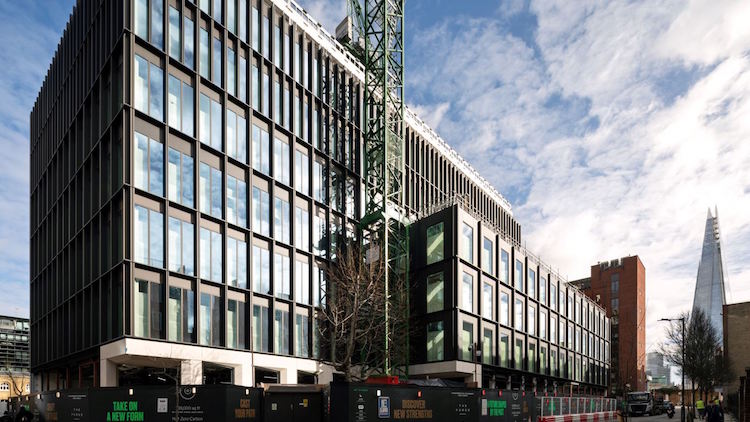
The Forge, a 139,000 sq ft office in Southwark, London, is Landsec’s demonstrator project for its platform design for manufacture and assembly (DfMA) strategy. Appointed by Landsec, Bryden Wood ran two teams in parallel through to RIBA Stage 3: one using traditional methods and the other using platform DfMA. The latter was chosen.
This demonstrated that DfMA could be used for 80% of the project.
The project brought together new and existing technologies, linked through a central ‘spine’ of data, to ensure offsite benefits were transferred onsite and evidence-based learnings were gathered to take on to future projects. Elements included platform design, algorithmic design, cassette design, digital delivery and automation.
Ultimately, Bryden Wood’s approach generated:
- a 2% increase in net lettable area (and an entire basement removed);
- improved safety (no work at height, no work in concrete);
- a 50% reduction in site operatives for superstructure and facade; and
- proof that platform approach first adopted by the Ministry of Justice can be re-used in other sectors.
Celebrate with the best
The winners of the Digital Innovation In Offsite Construction category, alongside the victors of the other 11 categories, will be revealed at the awards dinner on 12 July at the Brewery in London.
You can join them by booking your places at the awards. There is an early bird discount of 20% for those who book tables before 5pm on 20 May.
The Digital Construction Awards celebrate best practice and reward innovation in the application of BIM and digital technology in the built environment sector.
The awards are run by Digital Construction Week, the Chartered Institute of Building, and media titles Construction Management and BIMplus.
Awards sponsors include Revizto, Bluebeam, Procore, Autodesk, Solibri and the Association for Project Safety.
Don’t miss out on BIM and digital construction news: sign up to receive the BIMplus newsletter.